Art Not as Much of a Money Maker as Sports
"It's actually a lot simpler than y'all remember." It'south a Tuesday afternoon, and somewhat to my surprise, I'm on the phone to Paris Hilton, who is graciously explaining the world of NFTs.
Hilton is many things – a reality star, an heiress, an unlikely lockdown fettle guru who uses designer handbags instead of weights. But until now, she has never been considered a pregnant player in the art world. When artists have acknowledged her, often they've washed so to fetishise her image. In 2008, Damien Hirst bought a portrait of her by the creative person Jonathan Yeo, in which her body is constructed from collaged images cut from porn magazines.
Yet in the by year she'south become a surreal figurehead in the NFT scene: a world flush with crypto dollars and high on a hope to transform the worlds of fine art and commerce. When we speak, Hilton has just returned from a bitcoin conference in Miami, where customers paid up to $25,000 for VIP tables at the opening political party to watch her DJ in a pair of diamanté-encrusted headphones. "NFT stands for not-fungible token, a digital token that is redeemable for a digital slice of art," she explains. "Y'all tin can take information technology on your computer server or your phone. I have these screens in my house where I display them."
Certain enough, at Hilton'due south Beverly Hills mansion at that place are screens displaying NFTs she made in collaboration with the digital artist Blake Kathryn. These include a video of a chihuahua on peak of a rotating ionic column (a tribute to her deceased pet Tinkerbell) and an animated self-portrait of Hilton every bit a sparkling CGI Barbie floating in the clouds, a piece she's called Iconic Crypto Queen, and which she sold in April for more than $1m.
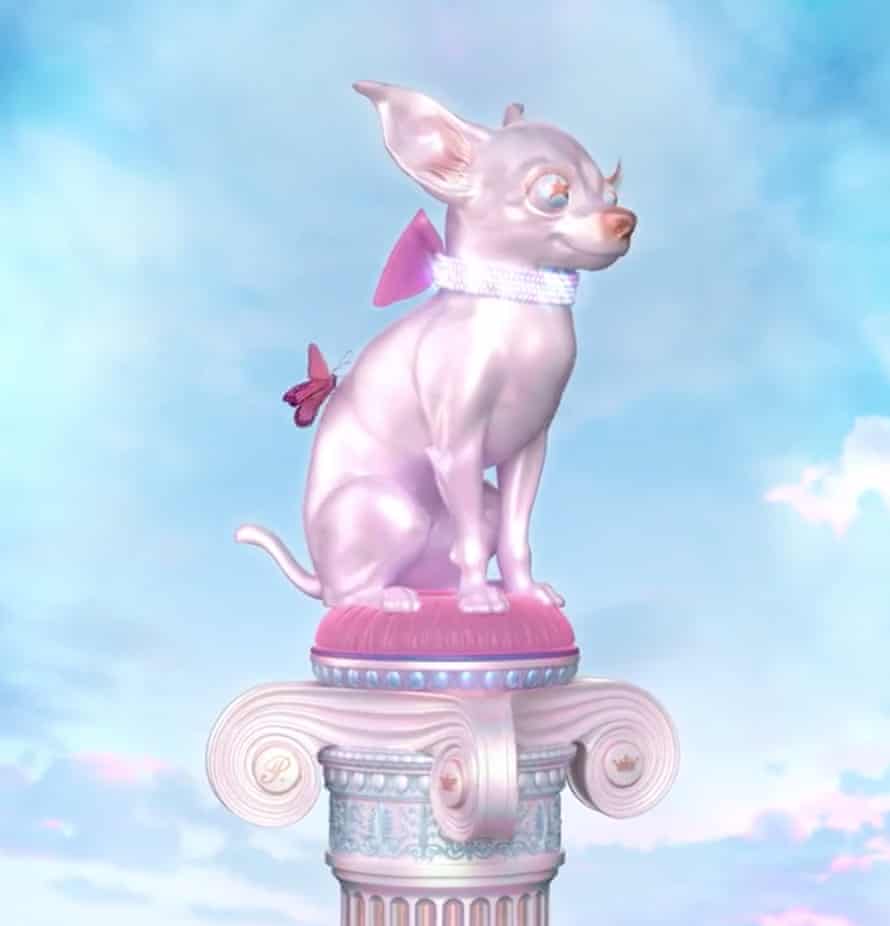
Hilton first started investing in cryptocurrency in 2016. "I became friends with the founders of Ethereum," she says. (Ethereum produces ether, the currency in which the bulk of NFTs are traded.) Since and then she'southward thrown herself into collecting crypto art, and owns more than 150 NFTs.
To advocates of the NFT, the technology offers a revolutionary new way of selling art, and of circumventing snooty cultural gatekeepers whose resistance to a crypto hereafter seems as square as the 19th-century Parisian art world'due south disdain for impressionism. In this context, the relevance of Hilton'due south make to the NFT motion makes sense. Pink, jewel-encrusted, and openly motivated past beingness as rich and famous as humanly possible, she's a far cry from the type of person whose piece of work is typically exhibited in blue-chip galleries or hung in booths at fine art fairs.
Still Hilton's endorsement may too be ammunition for those who view the NFT as merely another depressing example of the speculative logic of finance monopolising taste. To detractors, from critic Waldemar Januszczak to artist David Hockney, the NFT market place is a home for morally broke, environmentally vandalistic money-grabbers whose creations barely qualify as art.
While well-nigh of united states of america are still trying to call back what "fungible" means, a battle is under way to define how NFTs are understood. Are they a vital cultural production that tells us something profound virtually digital consumerism? Or are they just the latest cynical way to make absurd amounts of coin?
A motley coiffure of celebrities have tried their hand at selling digital art, including Snoop Dogg, Lindsay Lohan and John Cleese. In July, it was estimated that sales of NFTs in the offset half of 2021 rose by more than $2bn (£1.47bn) – a trend that prompted Christie'southward and Sotheby'due south to host their own NFT auctions and that is credited with driving gimmicky art sales to an all-fourth dimension high. But simply a tiny proportion of the gain of art NFTs take ended up in the banking company accounts of the galleries that accept, in addition to sale houses, traditionally taken the lion's share of art-market profits.
In March, the crypto business firm Injective Protocol paid $95,000 for Morons, a physical artwork by Banksy depicting an auctioneer selling a framed motion picture bearing the words: "I can't believe you morons actually buy this shit." They and then burned the picture earlier selling a digital token of the piece of work for $380,000. The event was a marketing ploy, designed to stoke outrage, drum up publicity and plough a profit. However the symbolism was potent: digital art is here to replace its physical forebear, and its coming supremacy should be reflected by a college price tag.
In essence, an NFT is a digital certificate of ownership, nigh ever bought and sold using cryptocurrency, to which any digital file – a jpeg image file, a video, a song – can be attached. That Hilton is able to brandish Iconic Crypto Queen in her domicile, despite having sold it, is office of the NFT's appeal – and the challenge it poses to the established business concern model for trading and accessing art. With a elementary Google search, everyone tin discover and download the file associated with an NFT for cipher, and store information technology on their phone or computer, but merely the owner has the right to sell it. Each NFT is unique, and all transactions are logged on the blockchain, a type of database invented in 2008 for the purpose of recording the movement of cryptocurrency.
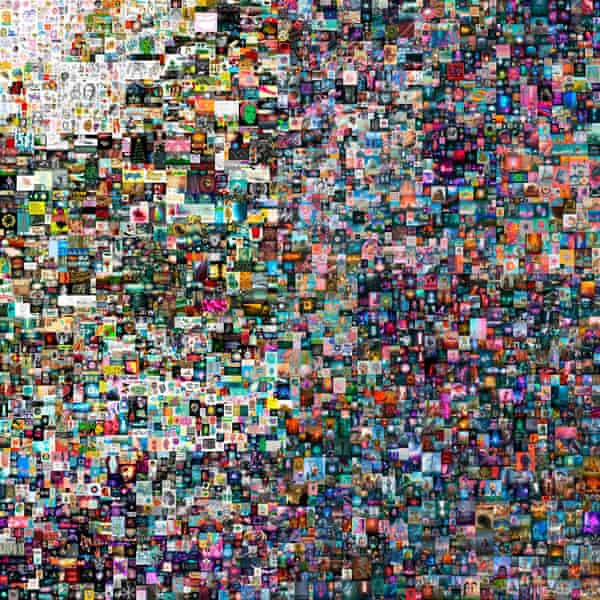
Unlike the commercial gallery business model, NFTs are designed to cutting out the need for fine art dealers, enabling artists to trade directly online, typically via specialist auction sites. Crucially, in dissimilarity to the contemporary fine art world, in that location is no "vetting" of collectors – a practice intended to terminate the well-nigh speculative buyers flipping artworks by quickly reselling them at a profit. Everyone tin can buy an NFT, and prices, so often a thing of mystery in high-stop commercial galleries, are listed every bit a matter of public record. Every time an NFT is resold, its creator also makes a turn a profit – an inbuilt royalty system missing from the concrete fine art earth, where artists often feel as if they have been shafted when their work is resold on the secondary market.
A model for trading and sharing fine art, built on the principles of financial transparency, royalties and piece of cake access for all may sound egalitarian. The reality has been rather dissimilar. As shortly as it became credible that almost annihilation digital could exist labelled equally art and sold, the circus rolled into town.
In March, Everydays: The Starting time 5000 Days, a collage of previous artworks past a 40-yr-erstwhile American named Mike Winkelmann, improve known as Beeple, sold for $69.3m at Christie'south New York. After that, Kate Moss sold a gif of herself for more than $17,000. Jack Dorsey, CEO of Twitter, sold an image of the first e'er tweet for $two.9m. A Brooklyn film manager managed to sell an audio file of his ain farts for $85. Dominic Cummings even threatened to use the applied science against Boris Johnson, by releasing what he said was evidence of regime malpractice in the form of an NFT.
Along the way, the marketplace became gratuitously inflated. Bidders at the top stop included Vignesh Sundaresan, a blockchain entrepreneur who bought Beeple'south $69m NFT. A considerable number of small-fourth dimension enthusiasts were also buying at the affordable finish of the market, keen to gloat the technology by investing in blockchain art. Information technology didn't accept long earlier the bubble outburst. By May, daily sales of NFTs had dropped by 60%. Crypto art'due south reputation has also taken a knock considering of its awful ecology runway record. (The annual energy consumption of Ethereum is estimated to equal that of Iceland.)
Despite this, advocates still believe NFTs can mount a challenge to the monopoly on trading fine art held by commercial galleries, and even create a hereafter where physical artworks are replaced by their digital counterparts. As Hilton puts it: "In that location are paintings out there that are $100m or more, but if you think about it, it's really just canvas with paint."
I north the first, before the circus pitched upwards, in that location were nerds. Inevitably, because this is the internet, at that place were also cats. CryptoKitties, to be precise, is an online game launched in 2017, enabling players to merchandise and "brood" unique drawing felines, sold as NFTs, using blockchain technology. Although the first NFT was created by a man named Kevin McCoy in 2014, CryptoKitties attracted attention and money, with some cats trading for hundreds of thousands of dollars. During 2020, as cryptocurrencies boomed and the pandemic accelerated our transformation into a species of screen-obsessed zombies, interest in NFTs rapidly picked upwardly pace. As a consequence, the value of work by a relatively small number of artists already on the scene rocketed.
Among them was Trevor Jones, a 51-year-old painter who lives in Edinburgh. Yous've probably never heard of Jones, but he's the nearly successful NFT artist working in the United kingdom. He started making NFTs in 2019. "V years ago, I was struggling to pay the mortgage," he tells me. "I went from having to borrow money from friends to pay the bills to making $4m in a day."
Jones has made a name for himself combining painting with digital technology, often producing pastiches of famous artworks with a crypto twist. In 2020, Bitcoin Bull – an blithe painting of a Picasso-inspired bull, decorated with bitcoin logos and Twitter birds – was bought by a prominent crypto collector named Pablo Rodriguez-Fraile for $55,555.55.
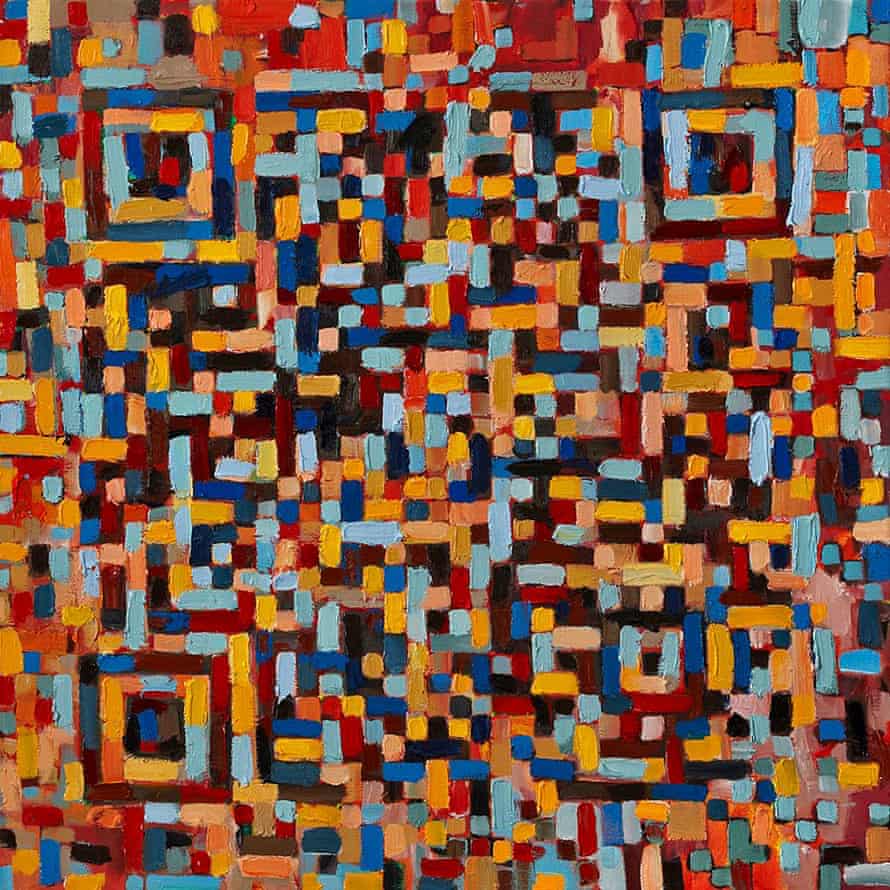
Jones is warm, unguarded, and stunned by his rapid ascent. "I grew up in a piffling logging community," he says of his babyhood in western Canada, a place he describes as "crude". "When I was 25, a friend of mine ended up getting into a fight at a bar and was killed." He left soon afterwards, somewhen settling in Edinburgh, where he worked at the metropolis'due south Hard Rock Cafe every bit a waiter and later as a director.
Jones tells me about the mental health crisis he suffered in his early 30s. "My girlfriend and I bankrupt up and it kind of all came crashing down. At that betoken, it sounds cliched, but I decided I needed to find something to salvage me."
He set his eye on condign an artist and "begged" his mode on to an fine art foundation grade at Leith School of Art, which he followed with a degree at the University of Edinburgh.
Things began to look up for Jones in 2012, when he had the thought of incorporating QR codes into his art, painting the scannable barcodes in Mondrian-like colours on canvas. Scanning the paintings takes viewers through to an online gallery, where anybody can upload their piece of work. "People were laughing at me at the time," he says. While gallery audiences turned their noses upwardly, he gained a new post-obit online, ane that would plow out to have deep pockets.
In 2019, Jones began working with animators to turn his paintings into brusque videos that he sold every bit NFTs. Among his well-nigh successful works is Bitcoin Angel, an NFT based on Bernini's baroque masterpiece The Ecstasy of Saint Teresa, which he sold in 2020 for the equivalent of more $3m (all of Jones'southward NFTs are bought using cryptocurrency). In Bernini's marble sculpture, a nun has been stabbed in the center by an angel with a spear. She leans backwards, overcome by the sublime ecstasy of being penetrated past a heavenly torso. When the pointer pierces the centre of Jones's nun, she bleeds bitcoin.
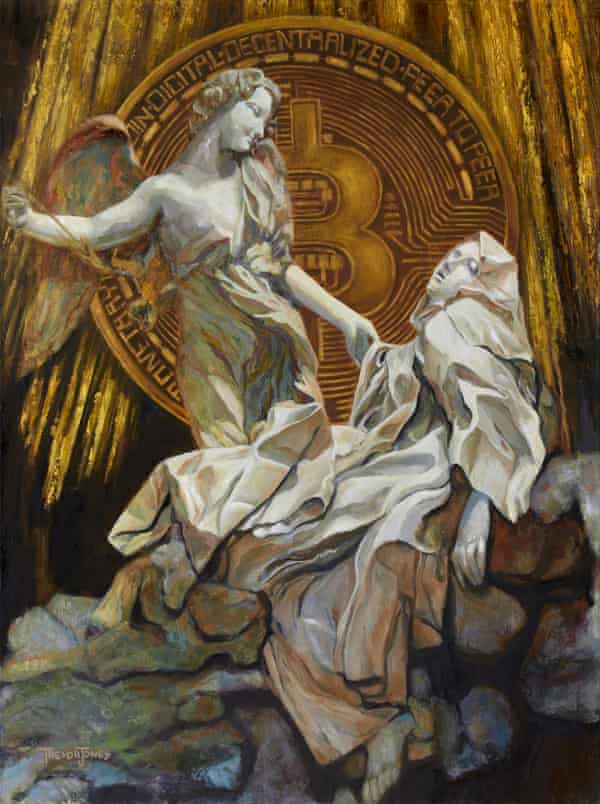
To sell Bitcoin Angel, Jones used a website called Great Gateway, one of a number of online auction sites designed for trading NFTs that are at present flooded with aspiring crypto artists. I dedicated an afternoon to scrolling through the lots, each one flashing and jiggling in the hope of attracting the attention of collectors. I saw gifs of muffins transforming into dogs, spinning trainers, sycophantic portraits of Elon Musk and an abundance of naked, large-boobed cyborgs. The art critic Dean Kissick described the male-dominated NFT scene as "Etsy for guys", and on this evidence it's easy to see why. Aside from the headline-grabbing sales, Cracking Gateway provides a platform for aspirational entrepreneurs and hobbyists, who exercise their craft on computers rather than knotting macrame establish hangers.
While those – like Jones – who successfully rode the NFT wave were busy counting their crypto dollars, over the past year the conventional fine art world has suffered a decline. During the pandemic, with audiences unable to physically nourish exhibitions and fairs, art dealers take struggled to make online viewing rooms interesting or lucrative. As a consequence, global sales of fine art fell past 22%. To rub salt in that wound, millions of crypto dollars were exchanging hands for a natively digital art form. "The technology is designed confronting the existing fine art world," says Noah Davis, a specialist at Christie'south New York. "It's an art form that doesn't demand a gallery."
It was Davis who helped to sell Beeple'southward $69m NFT, the kickoff piece of crypto art ever listed by a major sale house. He views his own touch on as pivotal: "I introduced NFTs to the Christie's audition and thereby the world," he says. The artwork was sold during an online auction in March that took ii weeks to close. Behest opened at $100, and within an hour that figure had risen to $1m – the event of a vast number of bids all happening digitally. "I've never seen annihilation then spectacular. You can't bid that quickly at auction unless you just shout out: 'A meg bucks,'" Davis says, "and that's incommunicable to exercise online. And so all that bidding had to happen in increments and manually.
"I await at my life as pre-Beeple and mail-Beeple," he adds. "The same way the world thinks most before Jesus Christ and after. Beeple is kind of my Jesus."
In the months since, Christie's has connected to cash in on NFTs. In May, information technology achieved $sixteen.9m for nine pixellated cartoon characters from the CryptoPunks series, early on examples of NFT art that take become sought-afterwards collectibles. Christie's has also attempted to unite the crypto and mod fine art markets. This spring, it hosted a sale of digital artworks made by Andy Warhol in the 1980s. The images, which had been recovered from floppy disks and transformed into NFTs, include drawings, made on the artist's Commodore Amiga figurer, of bananas, flowers, and of a Campbell'due south soup tin that alone sold for more than than $1m.
In full general, the commercial gallery world has been understandably chary about adopting technology designed to circumvent it. Backside the scenes, all the same, a number of galleries have attempted to woo Jones. He has declined their advances. "What can a commercial gallery exercise for me?" he asks. "Having a gallery exhibition before, I worked a year creating paintings, I paid for all the framing, the overheads for the studio. I had the paintings delivered to the commercial gallery. I may or may not sell, the gallery takes 45 to 55% commission, and they might pay out a month, 6 weeks, two months subsequently." And now? "I sell something and three minutes later I've got the money in my digital wallet."
A t times, the divide betwixt the two art worlds seems more profound than a divergence in business organisation model: information technology'southward an all-out civilization clash. "Few of these cyber-millionaires could tell the back of a Rembrandt from the front," wrote art critic Waldemar Januszczak. "There is no challenge whatsoever in NFT art," conceptual fine art collector Pedro Barbosa told the New York Times, arguing that the ideas behind NFTs are oft derivative, having "already been explored by artists like Josef Albers, László Moholy-Nagy, and Marcel Duchamp". David Hockney branded NFTs "silly little things" for "crooks and swindlers" – a curious accusation from an artist happy to embrace and monetise novel digital technology. Since 2009, Hockney has been doing a roaring trade in souped-up iPhone and iPad drawings.
Jones tells me that the crypto true-blue, who, like Hilton, ardently believe that NFTs are the future of art, now use the dusty epithet "the legacy art world" to refer to their physical rivals.
As a painter, Jones is unusual among NFT artists. On occasion, this has allowed him the opportunity to sell the original painting on which an NFT is based, every bit well equally the NFT. Pulling off this kind of double sale, yet, must be handled carefully. Charging more than for a painting than an NFT, and thus valuing concrete fine art more highly than digital art, could provoke the ire of the crypto crowd. When Jones sold Bitcoin Balderdash to Rodriguez-Fraile, he also sold the original painting to the second-place applicant. In club non to offend his fans, he priced the painting at $55,000 – $555.55 less than the NFT.
A handful of established contemporary artists, notably those who have class when it comes to explicitly courting headlines and extreme wealth, have tried their hand at making NFTs – almost prominently Damien Hirst, who released the project The Currency in July. Hirst put 10,000 NFTs upwards for sale, each respective to a unique spot painting, for $2,000 a piece. But there is a catch: subsequently two months, the collector must decide if they wish to keep the NFT or the physical art work. Whichever one they don't choose volition be destroyed, forcing the owner to chance on which version volition be more than valuable in the future.
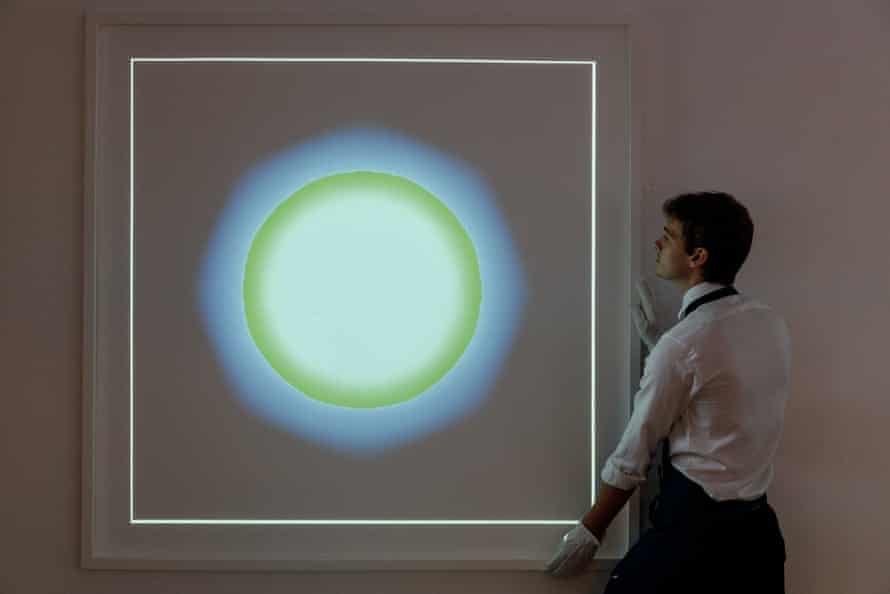
The most shocking attribute of the NFT to the art intelligentsia is its brazen entanglement with finance. Trading art has always been a pastime of the wealthy. Much of what counts for art history consists of flattering portrayals of the rich and powerful, and artists accept long been expected to perform what Tom Wolfe called the Art Mating Ritual – attracting the interest of wealthy patrons and conservative institutions, while simultaneously presenting as Bohemians and renegades. Yet with the NFT, the distinction between art and asset seems to have disappeared. In place of the curated exhibition is the auction website; symbols of the market accept seeped into the artful language of the art itself. Prices, not ideas, dominate.
Despite the promise of "fine art for everyone", the last destination of the NFT might non actually be art. Art may but be a useful way to advertise the possibilities of a new technology. "I've done everything from fashion, fragrances to endorsements," Paris Hilton says, adding that NFTs are another style for "fans to take a piece of me". Besides as working with the rapper Ice Cube, Jones recently made an NFT for the whisky company Macallan, to be auctioned alongside a very expensive cask of scotch. This, it seems, is a gustatory modality of where NFTs may be heading: not a radical new model for trading art, only a digital marketing bauble.
Perhaps the almost significant legacy of the NFT's assault on the art market place will exist the questions it forces us to ask most the nature of art, and what it is that we want from it. How should fine art exist traded and viewed? Who gets to ascribe value to fine art? Is there a moral or aesthetic code by which artists are expected to work, and who has elected themselves to ascertain it? And why would anybody role with their money in exchange for a digital fart? Then in that location'southward the biggest question: is there a meaningful difference between an artwork and an asset? The answer, perhaps, is not always – but if we want art to be more than a tool for prettifying finance and flogging merch, then information technology's an ideal worth holding on to.
Source: https://www.theguardian.com/artanddesign/2021/nov/06/how-nfts-non-fungible-tokens-are-shaking-up-the-art-world
0 Response to "Art Not as Much of a Money Maker as Sports"
Post a Comment